Engineered for the Long Run: How Kenya's Refurbishment Economy Is Rewriting the Rules of Product Design for US Manufacturers
The Market That Built Its Own Expertise
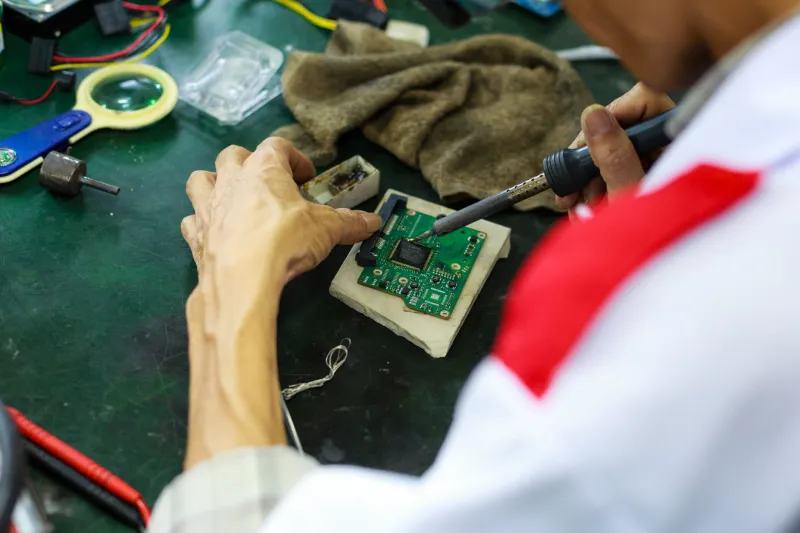
Walk through the Luthuli Avenue electronics corridor in Nairobi and you encounter something that has no direct equivalent in any American city: a dense, highly specialized market for refurbished technology where the expertise is not incidental but central. These are not pawnshops. They are diagnostic environments—places where technicians assess component-level failure, source compatible replacements across multiple device generations, and return equipment to functional service with a precision that most US consumers would find remarkable.
This market exists because it had to. Import costs, infrastructure constraints, and income realities across Kenya's technology consumer base made the refurbishment economy not a lifestyle choice but an operational necessity. And like most constraints that persist long enough, it generated expertise.
That expertise is now a competitive asset with global relevance—and US manufacturers are beginning to recognize how much ground they have conceded by designing it out of their own operations.
What Planned Obsolescence Actually Costs
The business model of planned obsolescence is well-understood: design products with intentional lifecycle limits, create upgrade incentives at regular intervals, and capture recurring revenue from a customer base that has been trained to replace rather than repair. For decades, this model produced reliable margin structures for consumer electronics, enterprise hardware, and industrial equipment manufacturers alike.
The costs of the model, however, were always real—they were simply distributed to parties other than the manufacturer. Consumers absorbed replacement expenses. Landfills absorbed the physical waste. Supply chains absorbed the pressure of continuous new-unit demand. Regulatory bodies, particularly in the European Union and increasingly in US states, began absorbing the political cost as circular economy legislation moved from proposal to enforcement.
Kenyan firms never had the luxury of externalizing those costs. When a router fails in a Nairobi small business, the response is not a purchase order for a replacement unit. It is a diagnostic process, a component-level repair, and a return to service. The business owner who manages this process across a ten-year equipment lifecycle develops an understanding of that hardware—its failure modes, its tolerances, its upgrade pathways—that no warranty replacement program ever produces.
Modular Thinking as Competitive Architecture
The engineering discipline that emerges from Kenya's refurbishment culture is not merely about fixing broken things. It is about designing and selecting systems with repairability and modularity as primary criteria rather than afterthoughts.
Kenyan IT infrastructure managers evaluating enterprise hardware purchases apply a framework that most US procurement teams have no formal equivalent for: they assess not just initial cost and performance specifications, but component availability across multiple supplier generations, community repair documentation, and compatibility with systems they already operate. They are, in effect, underwriting the total cost of ownership across a decade rather than a depreciation cycle.
This framework produces different decisions. It selects for hardware with accessible internal architecture over sleek, sealed designs. It favors vendors with transparent parts ecosystems over those with proprietary replacement components. It treats software lock-in as a risk factor rather than a feature.
For US companies now facing right-to-repair legislation, sustainability reporting requirements, and supply chain fragility from single-source component dependencies, this framework is not an academic curiosity. It is the operating model they need to build—and Kenyan firms have been running it for years.
The Skills Gap That Refurbishment Fills
Beyond the hardware economics, Kenya's refurbishment ecosystem has preserved a category of technical skill that US manufacturing culture has systematically devalued: component-level diagnostic and repair competency.
American technical education and corporate training have, over the past two decades, oriented almost entirely toward system-level integration and software configuration. The ability to diagnose and repair at the hardware component level—to understand why a specific capacitor fails under load, how to recalibrate a sensor after replacing its housing, how to adapt a legacy component to a newer system architecture—has become scarce in the US technical workforce.
Kenyan technicians trained in the refurbishment economy possess this competency as a baseline. It is not a specialty; it is a prerequisite. And as US manufacturers confront the combined pressures of supply chain disruption, sustainability mandates, and aging enterprise infrastructure, this competency is becoming a sourcing priority rather than a nice-to-have.
Kenya DT's Technology & Outsourcing practice has documented a measurable increase in US client inquiries specifically seeking Kenyan technical talent with hardware lifecycle management experience—a category that barely existed as a formal search criterion three years ago.
From Niche to Necessity
The circular economy is no longer a sustainability marketing frame. The EU's Ecodesign for Sustainable Products Regulation, the US Federal Electronics Stewardship commitments, and the growing pressure from institutional investors on supply chain waste metrics have transformed circular design from a competitive differentiator into a compliance requirement.
US companies scrambling to retrofit circular principles into product lines engineered for obsolescence are discovering that the expertise they need is not primarily in their domestic consulting market. It is in markets that never had the option of designing for disposal.
Kenyan firms that built their technical capabilities in the refurbishment economy are not simply vendors of repair services. They are repositories of a design philosophy—one that treats every product as a system that will require maintenance, adaptation, and eventual component harvest. That philosophy, applied to US product development and procurement strategy, produces hardware that lasts longer, fails more predictably, and costs less to maintain across its full operational life.
The American obsession with the next version has produced remarkable innovation. It has also produced remarkable waste, remarkable vulnerability to supply disruption, and a remarkable skills deficit in the workforce responsible for keeping existing systems operational.
Kenya's refurbishment economy built the antidote. US manufacturers would be well-served to study the prescription.